
Germanic ancestor veneration

(Das deutsche Original findet man hier.)
Over the years, I have subjectively observed that although many pagans worship the gods in one form or another, significantly fewer care about the land wights, and only a small proportion engage in ancestor veneration.
When asked why this is the case, at least with regard to ancestor veneration, it is often claimed that there is no reference to ancestor worship in Germanic sources, or that it is not important.
Neither of these claims is true.
Key characteristics of Germanic ancestor worship throughout history
- Spatial connection: Ancestors were often buried on the farm or near the center of the settlement.
- Ongoing relationship: Ancestors appear in dreams or visions.
- Regular sacrifices: Food, drink, animal sacrifices at certain times of the year.
- Cultic sites: Mountains, hills, burial mounds as ancestral seats.
- Integration into the annual cycle: Festivals such as Mōdraniht, Disablót.
Let's start with the historical sources
There is clear evidence that ancestor veneration played a role in heathen Germanic culture, both in written sources (mostly late, often handed down by christian writers) and in archaeological findings and indirect references from folk beliefs and customs.
As always, I make no claim to completeness.
Written evidence among the Germanic peoples on the European continent
1. Tacitus, Germania (ca. 98 AD)
In chapters 2, 7, 18, and 20, Tacitus describes the importance of the sib (clan) and ancestors for the Germanic tribes. In chapter 2 in particular, he emphasizes that the Germanic tribes learn about the beginnings and origins of their peoples from “ancient songs”:
“Celebrant carminibus antiquis ... originem gentis conditoresque deos commemorant.”
“They sing in ancient songs ... about the origin of their race and their divine ancestors.”
This is probably the clearest non-Christian evidence of ancestor worship among the Germanic peoples.
2. Early Medieval Chronicles and Poetry
a) The Old English poem Widsið (Well-traveled; 7th century, Anglo-Saxon, but with continental Germanic motifs)
The poet lists over 200 kings and tribes.
Many names are historical rulers (e.g., Ermanaric of the Ostrogoths, Offa of the Angles, Sigehere of the Sekgones).
They appear as a gallery of ancestors of Germanic history, preserved through recitation.
It does not describe a cultic act of ancestor worship, but it is itself a monumental testimony to genealogical memory culture, and this is precisely where its connection to ancestor worship lies.
b) Lex Burgundionum (Law of the Burgundians; 6th century)
No direct evidence of worship, but genealogical structures of noble clans are strictly regulated in law and succession, which indicates a sacralized connection to ancestors.
c) Lombard tradition (Paulus Diaconus, Historia Langobardorum (History of the Lombards); 8th century)
At the beginning, the descent of the Lombards is recounted from the myths of ‘Wodan and Frea’.
The connection of an entire tribe with divine ancestors is a form of ancestor worship in mythical exaggeration.
3. Archaeological and epigraphic evidence with textual references
Matron inscriptions (1st–3rd centuries, most of which date from the 2nd century, in the Lower Rhine region, a Celtic-Germanic border area)
There are well over 1,000 votive stones dedicated to the Matronae (e.g. Matronae Aufaniae, Vacallinehae). About two-thirds of them are dedicated to Germanic matrons and one-third to Celtic matrons.
There is much debate among researchers as to whether these are ancestral mothers/tribal mothers.
Epigraphic texts: Deae Matronae ... pro salute sua et suorum - ‘To the matrons ... for the salvation of the founder and his family.’
Here, an ancestral and family connection in the cult may be directly discernible in writing.
4. Ecclesiastical prohibitions as negative evidence among the Germanic peoples on the continent
These are often the clearest sources because they explicitly prohibit what was actually practised.
a) Capitulatio de partibus Saxoniae (Capitulation of Parts of Saxony; ca. 782, issued by Charlemagne):
-‘Si quis corpus mortui secundum ritum paganorum ad tumulum cum cantilenis et diabolicis ritibus sepelierit, capitale periculum incurrat.’
‘Whoever buries a dead person according to pagan custom with songs and devilish rites at the grave shall be punished with death.’
-‘Si quis diis vel demonibus, vel mortuis, sicut pagani faciunt, sacrificaverit...’
‘Whoever sacrifices to gods or demons or the dead, as the pagans do...’
Clear evidence that sacrifices to the dead were part of pagan rituals among the Saxons.
b) Indiculus superstitionum et paganiarum (Small Index of Superstition and Paganism; 8th century, probably written in Saxony/Franconia) lists Saxon pagan customs that are to be prohibited:
‘De sacrilegio ad sepulchra mortuorum’
‘On sacrilege at the graves of the dead.’
Note:
- This refers to sacrificial acts or cultic practices directly at the grave.
- ‘Sacrilegium’ here refers not only to ‘temple robbery’ but also to ‘pagan cult practices’ in general.
- Clearly refers to grave sacrifices / ancestral sacrifices.
‘De sacrilegio super defunctos, id est dadsisas’
‘On sacrilege against the deceased, that is, the dadsisas.’
Note:
- dadsisas is a difficult word to understand, probably from Old Saxon or Frankish.
- Interpretations in research:
- Corpse meal / funeral feast (funeral ceremony with food and drink).
- Possibly literally ‘funeral feast’ or ‘grave feast’.
- Clearly a reference to funeral feasts as ancestral rites.
‘De eo, quod sibi sanctos fingunt quoslibet mortuos’
‘About the fact that they make any deceased persons saints.’
Note:
- Shows that lay people or Christians influenced by paganism worshipped deceased ancestors or local dead persons as saints.
- Transitional phenomenon between ancestor worship and folk saint cult.
c) Synodus Leptinensis (Synod of Liftinae/Leptines, today Leffinge near Bruges; took place in 743, chaired by Boniface, on behalf of Karlmann, the mayor domus of the Franks. )
‘De sacrilegiis mortuorum, quod ad tumulos mortuorum diabolicas officias exercent.’
‘On the sacrileges in connection with the dead: that they perform devilish acts at the burial mounds of the dead.’
The synod deals not only with the cult of the dead, but also with sacrifices at sacred trees, springs, stones, divination, amulets, etc.
It is closely related to the Indiculus superstitionum et paganiarum (see above), which may have served as a supplement or working list for this synod.
d) Lex Alamannorum (Laws of the Alamanni, approx. 8th century)
“Si quis ad sepulchra mortuorum aut ad petras vel ad fontes vota reddiderit, vel lumina ad monumenta sanctorum aut ad mortuorum sepulchra in noctibus accenderit, solidos V culpabilis iudicetur.”
‘If anyone makes offerings at the graves of the dead or at rocks (altar stones?) or springs, or if anyone lights lights at the graves of saints or at the graves of the dead at night, he shall be found guilty and sentenced to five solidi.’
Prohibit the lighting of lights at night at graves (ad sepulchra), which was probably associated with soul or ancestor worship.
e) Concilium Moguntinum (Synod of Mainz; 847)
‘De sacrilegiis, quae quidam faciunt iuxta tumulos sanctorum vel mortuorum, et de parentali convivio, prohibemus omnino observari.’
‘We completely forbid the observance of sacrilegious acts performed by some at the burial mounds of saints or the deceased, and of the parental banquet (commemoration of the dead).’
Meaning
- ‘iuxta tumulos sanctorum vel mortuorum’: The synod makes little distinction between the graves of saints (Christian cult) and the graves of the deceased (pagan ancestor cult). Both were occasions for rituals that the Church wanted to prohibit.
- ‘parentale convivium’: The classical parentalia of Roman antiquity, i.e. funeral meals/ancestor celebrations. The continuity of such celebrations in the Frankish Empire is thus explicitly attested.
- The canon shows that ancestor worship through sacrifices and funeral meals was still alive in the 9th century, so much so that an entire council had to ban it.
5. Festivals & Customs
a) Winter commemorations
Commemoratio defunctorum (commemoration of the dead) took place in Carolingian monasteries in winter from early on.
Example: Fulda Monastery, 9th century, held a memorial service for the dead around Christmas.
(Gallic martyrologies (8th-9th century) also contain references to masses for the dead during the Christmas octave.)
b) All Souls' Day
Introduced in 998 by Abbot Odilo of Cluny, it spread throughout Europe in the 11th century.
The timing immediately after All Saints' Day (1 November) is almost certainly a Christian overlay on older ancestral festivals.
Archaeological evidence among the Germanic peoples on the European continent
a) Merovingian (approx. mid-5th century - 751) and Carolingian periods (751-919)
Many graves with traces of repeated burials: food remains, pottery, drinking horns.
Evidence found particularly in the Rhine-Moselle region and in Thuringia.
b) Reburials in the same mound
Multi-generational mounds in the Thuringian Forest (Haßleben-Leuna culture; Thuringians?), among the Franks and Alemanni, indicating a lasting attachment of the family to certain burial sites.
c) ‘Mortuaries’ and grave enclosures
Small buildings above graves (so-called grave houses, e.g. in Hessisch-Lichtenau; Chatti), possibly for post-funeral rituals, sacrifices, commemorative ceremonies.
d) Offerings of a cultic nature both in and around graves
Cup stones, incense utensils and food offerings are reminiscent of disablót-like rituals throughout the Germanic region.
A few examples:
- Trossingen (grave 58), Baden-Württemberg; approx. 580, Alemanni
Field bottle/drinking vessel with beer residues and opulent decoration; indicates a funeral meal/libation in an early medieval context.
- Langenpreising (Erding district), Bavaria, 7th century, Bavarians
Eggs (chicken/goose eggs) as food offerings, especially in children's graves. A typical motif of early medieval food offerings.
- Brücken-Hackpfüffel, Mansfeld-Südharz, approx. 480-530, Elbe Germanic context (Alemannic/Langobardic/Thuringian)
Princely burial mound with a circle of animal burials (including cattle/horses) around the central grave. Interpreted as an accompanying and food offering in the context of court/ancestor worship.
- Rhenish matron cult area (Bonn, Nettersheim, etc.), 2nd-3rd century, Ubii & neighbours
Numerous altars dedicated to the Matronae (maternal ancestor goddesses) with fruit baskets on their laps and depictions of incense/libation offerings (man scattering incense at the altar, companion with patera/jug). Clear evidence of food offerings and incense utensils in a (proto-)Germanic ancestor cult.
Written evidence among the Anglo-Saxons
1. Early medieval source
Bede the Venerable, Historia Ecclesiastica Gentis Anglorum (Ecclesiastical History of the English People; I, 15):
‘In illo autem anni circulo totidem fere mensibus sacrificia sua diis offerre consueverant. In quibus nonnulla etiam pro animabus defunctorum celebrabant.’
‘Throughout the year, they used to offer sacrifices to their gods in several months. Among these were also those celebrated for the souls of the deceased.’
Proves that sacrifices to the dead were an integral part of the pre-Christian calendar.
Mōdraniht
Mōdraniht (‘Mother's Night’) is described by Bede the Venerable in his De temporum ratione (On the Calculation of Time; Chapter 15; ca. 725).
"De decem et duobus mensibus Anglorum. ... Decembrem Giuli appellant. In hoc mense, qui est totus sacer, antiquiores populi noctem illam, quae nunc natalis Domini vocatur, ipsi vocitabant Modraniht, id est matrum noctem, ob causam, ut suspicantur, sacrorum, quae in ea pervigiles agebant."
‘About the twelve months of the Anglo-Saxons ... They call December Giuli. In this month, which was entirely sacred, the ancients called the night that is now called the birth of the Lord Modraniht, that is, Mother's Night, because of the reason, as one suspects, of sacrificial rites (sacra) that they performed while keeping vigil that night.’
Time: According to Bede, Mōdraniht fell either on the night of 24/25 December, i.e. Christmas, or on the winter solstice (21 December).
Interpretation: This is most likely a cult of ancestral mothers / matronae, comparable to the Rhenish matron cults. The name suggests the worship of female ancestral figures or tribal mothers.
Church prohibitions as negative evidence among the Anglo-Saxons
a)
- Paenitentiale Theodori (Penitential of Theodore; attributed to Archbishop Theodore of Canterbury, † 690; in reality probably an Anglo-Saxon compilation from the 7th/8th century)
‘Qui super defunctum cibum aut potum posuerit, vel ad sepulchrum comederit, III annos poeniteat.’
‘Whoever places food or drink on a deceased person or eats at the grave shall do penance for three years.’
- In the Paenitentiale Umbrense version (‘Umbrian Penitential’; specifically: the Umbrian version of Theodore's Penitential, which is considered the oldest version)
‘Si quis obtulerit hostias mortuis, XL dies poeniteat.’
‘If anyone offers sacrifices to the dead, he shall do penance for 40 days.’
b) Paenitentiale Ecgberhti (Penitential Book of Archbishop Ecgberht of York; -766)
- ‘Si quis sacrificium obtulerit mortuis, III annos poeniteat.’
‘If anyone offers a sacrifice for the dead, he shall do penance for three years.’
- ‘Si quis super sepulchrum cibum aut potum posuerit, I annum poeniteat.’
‘If anyone places food or drink on a grave, he shall do penance for one year.’
- ‘Qui ad convivia mortuorum venerit et ibi manducaverit aut biberit, III annos poeniteat.’
‘Whoever comes to the banquets of the dead and eats or drinks there shall do penance for three years.’
c) Canones Ælfrici (late 10th century, attributed to the Anglo-Saxon abbot Ælfric of Eynsham)
- ‘Ne sceal nan man deofolgyld wyrcan, ne to hæþenum hofan ne to hlæwum ne to hæþenra manna licum, ne ne ofre to stanas ne to treowum.’
"No one shall perform idolatrous sacrifices, nor go to pagan temples, nor to burial mounds (hlæwum), nor go to the bodies of pagan people, nor offer sacrifices to stones or trees."
- ‘Ne sceal nan man deade mid mete ne mid drincum gelæstan, ac man sceal his sawle mid mæssan and gebedum gehelpan.’
‘No one shall provide food or drink to the dead, but one shall help their souls with masses and prayers.’
- ‘Men bringað mete and drinc to deadum mannum, and þæt is deofles weorc.’
‘People bring food and drink to dead people, and that is the devil's work.’
Archaeological evidence among the Anglo-Saxons
a) Anglo-Saxon cemeteries (e.g. Yeavering, Spong Hill, Sutton Hoo, Prittlewell)
- Evidence of ritual offerings of food, drink and animals.
- Partially recurring, which suggests memorial feasts.
b) House burials:
In some settlements, the dead were buried in or directly adjacent to the living area, which indicates a house ancestor cult.
c) Here, too, there are grave goods of a cultic nature both in and around graves.
Examples:
- Scremby, Lincolnshire, 6th century, Anglo-Saxon (Angles/Lindsey)
A Roman cup with traces of pig fat was found in a girl's grave. Presumably placed in the grave as a food/fat offering.
- Sutton Hoo, Suffolk, East Anglia, early 7th century.
Animal bones/burned remains (cattle, pig, sheep, etc.) and vessels were found in several mounds. The findings are interpreted as funeral feasts/celebrations at the grave.
- Anglo-Saxon burial grounds in general (e.g. Cleatham, Millgate/Newark)
Often vessels, animal bones, traces of burning. Grave food/drink, repeated commemoration at the grave (synthesis of the findings in the study ‘Feasting the Dead: Food and Drink in Anglo-Saxon Burial Rituals (Anglo-Saxon Studies, 9, Volume 9)’ by Christina Lee).
Linguistic and folkloric reflections among the Anglo-Saxons
Old English mæġ-burh (‘kinsmen's burgh’)
Referred not only to a family, but also to the family association protected by ancestors and the dead.
Place names:
Some Anglo-Saxon and continental Germanic place names combine a person's name + ‘haugh/haugr’ (hill) or ‘byrgen’ (grave), which can have cultic significance.
Written evidence in Scandinavia
a) Landnámabók (Book of Settlements; 13th century, based on older traditions)
Describes how settlers in Iceland often combined the settlement of land with the establishment of a farm sanctuary (hof) and sometimes buried their dead relatives on or under the farm floor. This indicates a cultic connection to the ancestors.
‘Þar var hofit, ok þar var heygðr faðir hans.’
‘There was the sanctuary, and there his father was buried.’
b) Eyrbyggja saga (Saga of the People of Eyr; 13th century)
Told by Thorolf Mostrarskegg, who emigrates to Iceland and builds a farm. Graves of family members are laid out near the farm, and the farm hall also serves as a cult centre.
It also tells of the so-called Helgafell, a mountain where the souls of the family go after death, recognisable as a kind of ancestral seat.
‘Þar er mönnum ætluð hvíld í haugi þeim, er þar eru grafnir; allir menn fara til Helgafells þegar þeir deyja.’
‘There, the men who are buried there are destined to rest in the burial mound; all go to Helgafell when they die.’
c) Gísla saga Súrssonar (Saga of Gísli, son of Súr; 13th century; about events in Iceland in the 10th century)
- Gísli is visited by two women in his dreams (chapters 18–22). The ‘good’ dream woman protects and warns him, while the ‘bad’ dream woman heralds disaster.
‘Mér þótti sem Þórdís systir mín kæmi til mín.’
‘It seemed to me as if my sister Þórdís had come to me.’
These figures are strongly reminiscent of dísir (ancestral spirits) who accompany humans, both good and evil. They are an expression of the idea that ancestors/female guardian spirits intervene in the fate of the living.
After Gísli's death (he is killed by Thorgrímr gothi and his men), it is reported that his grave remains a place of remembrance.
Some manuscripts mention that his wife Authr mourns him for a long time and preserves his memory.
In Icelandic tradition, burial mounds were often continued to be used as family memorials and, in some cases, as places of worship.
d) Laxdæla saga (Saga of the inhabitants of the Salmon River Valley; around 1240, about events in Iceland in the 9th-11th centuries)
- After the death of important men, the saga mentions several times that burial mounds (ON haugar) are erected. These mounds are not only burial sites, but remain living points of reference in the consciousness of the community.
Example: Höskuldr Dala-Kollsson receives a dignified burial after his death, and his haugr continues to mark his importance. This shows that the burial mound served as a physical centre of remembrance, and such places in the North Germanic region were often associated with sacrificial and memorial rites.
The saga tells of draugar (revenants) who cause unrest. This idea that the dead remain ‘powerful’ is the basis of ancestor worship. The dead are not ‘gone’ but can still influence the living.
- Characters in the saga repeatedly have dreams about deceased relatives or figures that can be interpreted as dísir.
- The Laxdæla saga attaches great importance to the family trees and origins of its heroes. In doing so, it shows the close connection between the living and their ancestral line.
This genealogical preservation is itself a form of ancestor worship, the telling and recording of ancestry as a way of honouring the dead.
Archaeological evidence in Scandinavia
a) Burials at the house or in the courtyard area (permanent presence of ancestors)
- Scandinavia & Iceland:
Courtyards with nearby burial mounds, often directly adjacent to the living area. Examples: Hofstadhügel in Iceland, courtyards in Uppland (Sweden).
- Northern Europe in general:
Evidence of graves under floors or in the immediate vicinity of settlements (e.g. Haithabu finds), indicating the permanent presence and symbolic protection of ancestors.
b) Multi-generational burial mounds
In southern Scandinavia, Lower Saxony and Schleswig-Holstein (Haithabu), there are burial mounds containing multiple burials spanning several generations, often with areas of the mound used for ritual purposes (fire pits, sacrificial pits).
c) Offerings with a ritual function
Sacrificial remains (animal bones, pottery) in or next to graves, repeatedly deposited, are signs of recurring funeral feasts.
Examples:
- Vinjeöra (Skeiet), Trøndelag, Norway; Late Iron Age/Viking Age (approx. 500–950)
Several mortuary houses directly above graves; inside them, food offerings/animal remains and repeated cult rituals. The excavators explicitly interpret the buildings as places where the living ‘interacted’ with their ancestral dead.
- Gamla Uppsala, Uppland, Sweden, 6th–11th century, Svear
Cult landscape with royal burial mounds; post rows (archaeological traces of wooden posts erected in rows, which served either practical (house construction, fencing) or ritual (sanctuary, grave marking, cult area) purposes)/cult buildings and slaughter/animal bones as traces of blót/feasts at the burial ground (dynastic ancestor worship).
- Borre, Vestfold, Norway, 6th-10th century
Royal burial mounds; hall buildings directly in the burial ground for celebrations/rituals. This indicates recurring cult activities at the graves.
- Fyrkat, Jutland, Denmark, late 10th century
Grave of a völva (seeress) with henbane seeds (thrown on fire, probably to produce smoke and induce a trance), white lead ointment and a small bronze vessel with fat residues. Incense/ointment rituals as mediating practices to spirits/the deceased.
- Oseberg, Vestfold, Norway, 834 AD.
Buckets containing 6-7 wild apples were found in the ship burial as a classic food offering.
- Cup stones (‘Älvkvarnar’) in Uppland, Sweden, Bronze Age to historical times; local ancestor/spirit superstition.
Fat/sacrificial food was still being placed on cup stones in the 20th century (ethnographically attested in Veckholm). This indicates a continuous practice of sacrifice at cup marks, and the tradition goes back a long way.
Álfablót and Dísablót
Both Álfablót and Dísablót are understood in the Germanic pagan context as forms of ancestor worship, albeit with slightly different emphases and a certain degree of overlap.
I will explain the classification according to the written evidence:
1. Álfablót (Elves sacrifice)
The main source is Austrfararvísur (verses of an eastern journey) by the skald Sigvatr Thórtharson (11th century), who arrived in Sweden at the time of Álfablót. The housewife rejected him:
‘Ganga þú skalt, ok gjöra skalt eigi hér inn. Hér er blót, ok eru allir menn inni.’
‘You must move on and not enter here. There is a sacrifice here, and all the men are inside.’
Sigvatr mentions that this was a private house sacrifice, not public like the Jólablót.
Interpretation in the context of ancestor worship:
- In Old Norse tradition, álfar (English: elves) are sometimes closely equated with the dead or understood as glorified ancestors.
- Archaeological interpretation: Burial mounds in Scandinavia were often referred to as ‘elves' dwellings’ (álfabústaðir).
- In many cases, the Álfablót may have been a house or family death sacrifice in which the álfar were identical or related to the ancestral spirits.
- Time: Not entirely certain. Late autumn, around harvest time/beginning of winter (October/November). Research often sees it as parallel to the beginning of winter sacrifice (vetrnætr).
2. Dísablót (sacrifice to the Dísir)
Mentioned several times in the sagas and in Snorri's Heimskringla.
- Ynglinga saga, chapter 29: King Aðils of Uppsala dies during the Dísablót.
‘Var þar mikill veitsla ok blót mikit til árs.’
‘There was a great feast and a great sacrifice for the sake of the year's harvest.’
- Víga-Glúms saga, chapter 6: the hero sacrifices to the Dísir.
Interpretation in the context of ancestor worship:
- Dísir are female protective or fate spirits, often interpreted as personified ancestors (cf. Mōdraniht in Bede).
- In many texts, they appear in family contexts and watch over the welfare of the clan.
- The Dísablót was partly public (in Uppsala) and partly private, and depending on the context, could have included both ancestor worship and the veneration of other female guardian spirits.
- Time: spring, usually in February/early March, before the start of sowing.
3. In research, it is common (e.g. Jan de Vries, Rudolf Simek, Gabriel Turville-Petre):
- dísir (grammatically feminine; no masculine form known in literature) = female ancestral and protective spirits.
- álfar (grammatically masculine; no feminine form known in literature) = male ancestral and protective spirits.
This reflects a functional division: female dísir and male álfar are more commonly assumed, even though the texts do not explicitly limit álfar to men.
We note that Germanic ancestor worship consistently displays the following elements:
- sacrifices and feasts for the dead,
- burial mounds and clan rites,
- ancestors as protective powers,
- mythical ‘mothers’ and tribal ancestors,
- seasonal festivals, and
- a close interconnection between cult and genealogy.
The overall picture: ancestor worship was a central component of Germanic religiosity, both in the private family sphere and in the public legitimisation of rule.
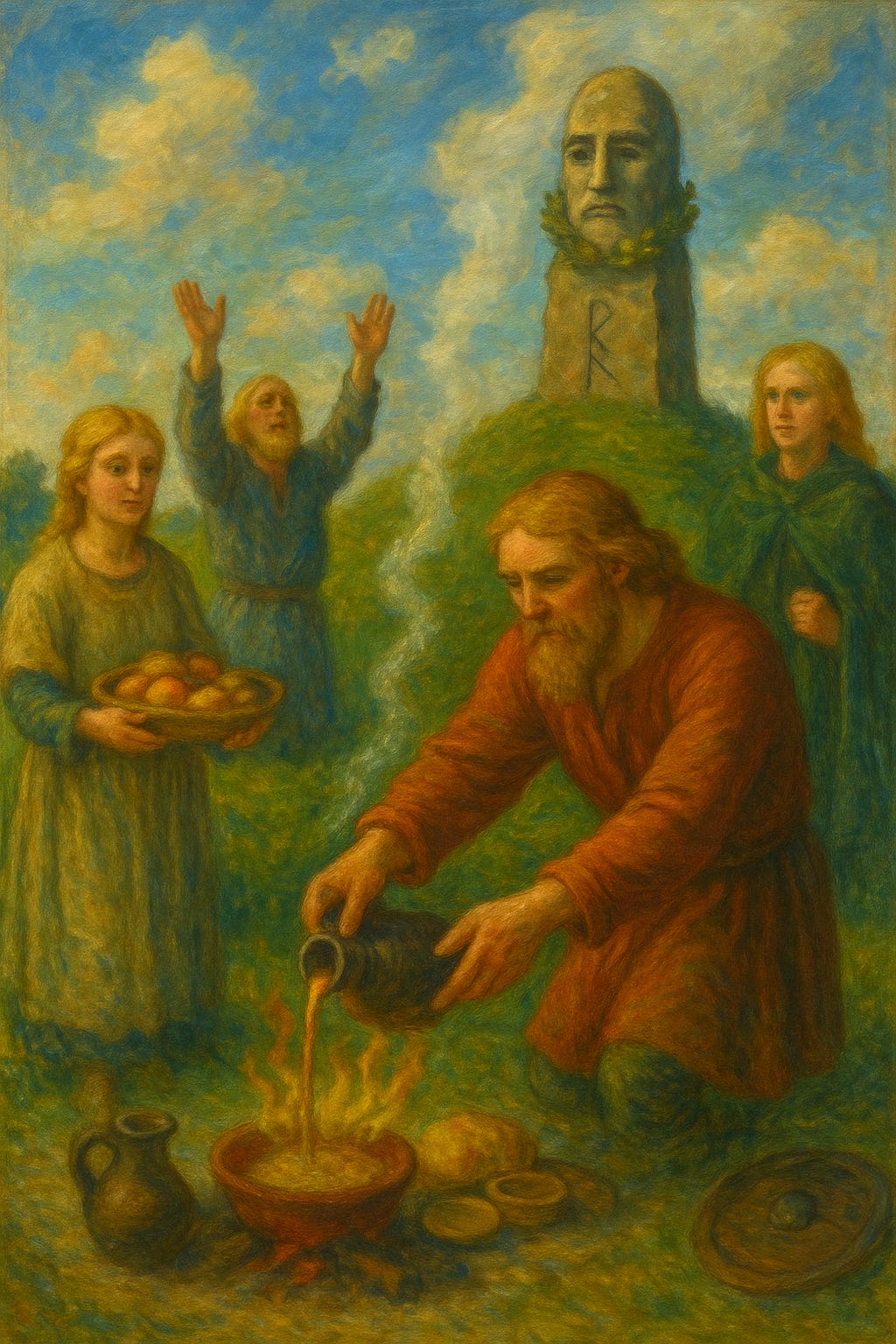
This also had an impact on Christian times:
Legal function of ancestors (óthal law) in the Middle Ages
In Scandinavia, there was óthal law (Norwegian: odelsrett, Icelandic: Óðalsréttur).
This meant that inherited land (óðaljörð) could not be sold freely, but had to remain within the clan.
Anyone who had a claim to land had to prove their genealogy, often back to the 5th generation.
This rule is contained in Norwegian laws (Gulathingslov, Frostathingslov, approx. 11th-12th century) and later in the Icelandic Grágás, among others.
The role of burial mounds is documented archaeologically and legally.
The mounds (ON haugr, English howe) of the ancestors remained visible markers in the land.
They served not only as a memorial, but also as a legal sign of ownership and succession.
In Old Norse literature, there are several scenes where burial mounds are referred to in connection with land claims.
Example: In Landnámabók, the burial mounds of ancestors are mentioned to legitimise claims of ownership.
In Icelandic and Norwegian literature, burial mounds are repeatedly depicted as places of worship: sacrifices, meals or invocations to the ancestors (e.g. Eyrbyggja saga, Laxdæla saga).
The combination with hörgar (hǫrgar), pagan places of worship made of stone, is also typical.
Prohibitions in medieval law books
From the 12th to 14th centuries, many Scandinavian laws contained clauses prohibiting pagan sacrifices at graves and hörgar.
Examples:
- Gulathingslov (ancient Norwegian law, revised in Christian terms in the 11th-12th centuries): Prohibits blót at pagan sites such as haugar, hörgar, lundir (sacred groves) and vatn (bodies of water).
- Kristinréttr Magnús Hákonarsonar lagabætis (‘Christian Law of King Magnús the Law Improver’, 13th century): Contains prohibitions on prayers and sacrifices at haugar and hǫrgar, explicitly as relics of pagan practice.
- Guta lagh (Gotland Law, 13th century): Provisions against pagan sacrifices and prayers at burial mounds (haugar) and sacred places.
- Kristinréttr Sverris konungs (‘Christian Law of King Sverri’, late 12th century): Also contains paragraphs prohibiting sacrifices at heiðin staðir (pagan sites), including burial mounds.
More than 300 years after official Christianisation, legal texts still had to emphasise that sacrifices and prayers were not permitted at burial mounds and ancient sanctuaries.
This shows that:
- Ancestor worship at burial mounds remained alive.
- It was perceived by the Church as a pagan danger.
- The laws aimed to suppress the practice by making prayers and sacrifices illegal.
Folkloric traces
Folkloric sources from Scandinavia, but also from Germany, tell of grave lights, offerings and feasts for the dead until the 16th and 17th centuries.
In Scandinavia, Yule remains a particularly strong time for ancestors. Even in the 17th century, clergymen complained about ‘pagan’ Yule customs.
Examples:
- the Swedish ‘Julbock’ (originally a sacrificial goat),
- food laid out for the ancestors on Christmas Eve,
- lights on graves.
Even in the 19th century, in parts of Sweden and Iceland, food was placed on the table ‘for the dead’ on Yule night.
What is the significance of ancestor worship in Germanic heathenism?
Ancestor worship is an essential part of Germanic heathenism because it places the living in a lasting community with the dead. It creates a direct connection between the past, present and future and gives each individual a firm place in their lineage.
- Identity and belonging: Ancestors provide a sense of origin and rootedness. Those who honour their ancestors know where they come from and gain orientation in the world.
- Protection and strength: The deceased continue to have an effect on the sib (clan); they provide luck, strength and support. Sacrifices and remembrance are expressions of the bond through which their help remains effective.
- Morality and responsibility: Ancestor worship obliges us to live with dignity and responsibility, not only towards ourselves, but towards the entire lineage from which we originate and which we continue.
- Community and justice: Ancestor worship strengthens family cohesion and the legitimacy of property, inheritance and land. It makes it clear that each generation is part of a larger whole.
- Health and prosperity: Those who integrate their ancestors into their own lives create harmony and bring blessings to their homes and farms.
Thus, ancestor worship is not a custom of the past, but remains a meaningful and viable practice today: it confers identity, binds people to the community, provides moral guidance and opens up access to protection and salvation through one's own lineage.
How can this be implemented today?
Germanic ancestor worship can be practised today without turning it into a mere re-enactment, i.e. not as a “museum ritual”, but as a living practice integrated into everyday life.
In doing so, one can follow the documented basic principles and adapt them to today's circumstances.
I will break this down into three levels: place, time, action; each with links to historical evidence.
1. Place - spatial anchoring
Historical:
- Ancestors often at the farm, in burial mounds near the house or on mountains/hills.
- Archaeological evidence of sacrificial pits and house burials.
Feasible today:
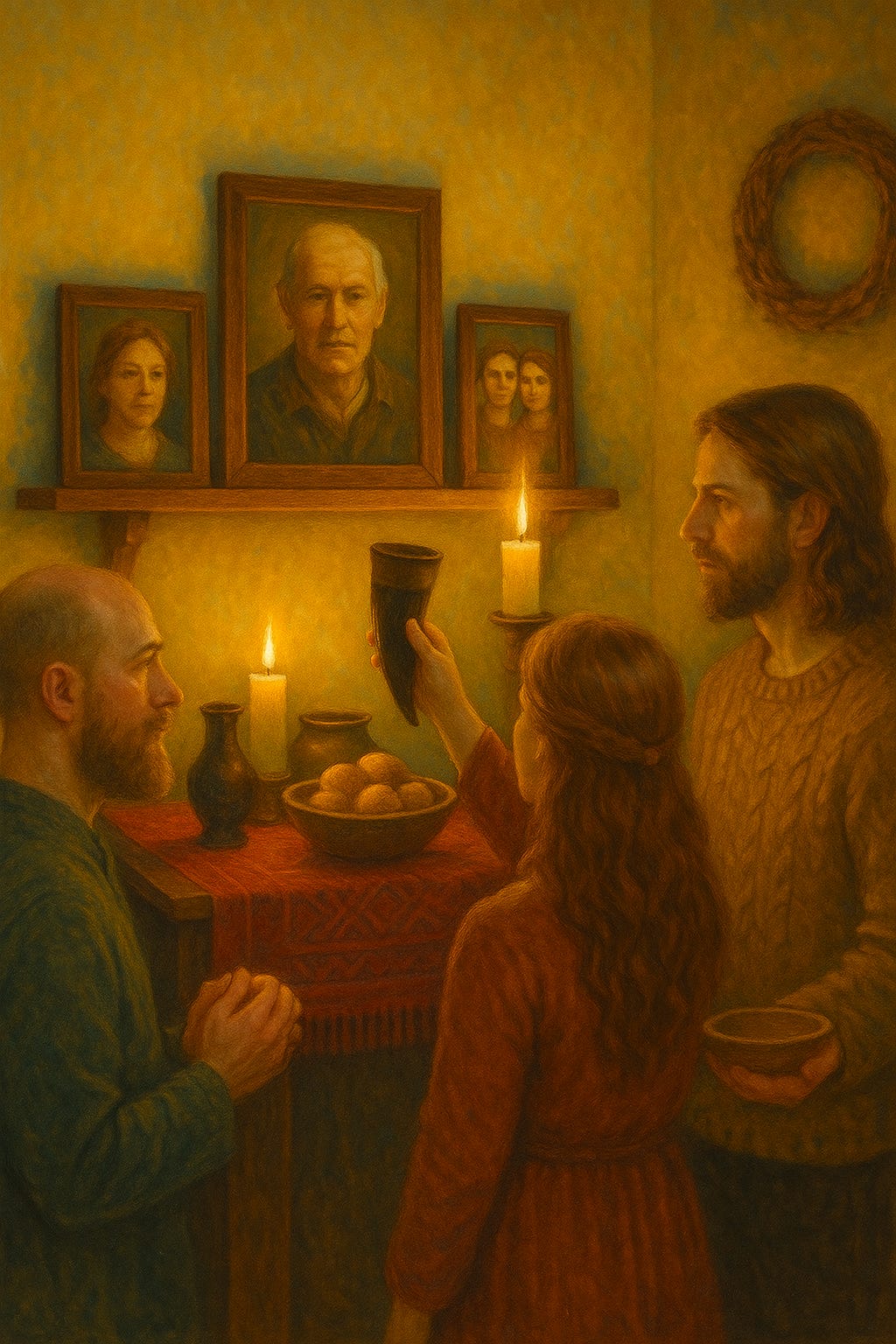
- Ancestral place in the house: small table, shelf or section of wall with photos, names, possibly symbols.
- Symbolic ‘mound’: stone or circle of plants in the garden/balcony representing the ancestral burial site.
- Location connection: always use the same place for ancestor worship so that it becomes ‘charged’ with energy.
2. Time - ritual rhythms
Historical:
- Annual festivals such as Mōdraniht, Dísablót, Álfablót.
- Church prohibitions document sacrifices on certain nights and seasons.
Feasible today:
- Choose annual festivals: e.g. Rauhnächte, beginning of spring, harvest time, winter night.
- Personal commemorative days: anniversary of death, birthday of an ancestor.
- Combination: combine ancestor festivals with seasonal foods (as historically: fruit, beer, meat, bread).
3. Action - ritual sequence
Historical:
- Food and drink offerings (Bede, Ælfric, Indiculus).
- Light and fire offerings (prohibitions in the Lex Alamannorum indicate this).
- Invocation and storytelling (sagas, dream encounters).
Can be done today:
- Clean the place (wipe it down, relight the candle).
- Food offering: set aside some of the meal and place it at the ancestral altar (bread, beer, fruit).
- Drink offering: pour a sip of mead, beer or water into a bowl or onto the ground.
- Invocation: Say the name, if necessary in Old Norse or Old German form (historically documented name).
- Story/memory: Briefly recount what has happened in the family. This promotes bonding.
- Thanks or request: e.g. for protection, assistance, advice.
4. Examples of short invocation formulas
I keep them linguistically close to the documented Germanic style (no modern pathos, rather simple):
- Old High German inspired:
‘Uuîhsa ist mīn hugi zi iu, fateru mīno, uuîsan mē.’
(‘My mind is devoted to you, my fathers, be wise to me.’)
- Old Norse-inspired:
‘Heilir feðr ok mæður, haldið vörð um ætt mína.’
(‘Greetings, fathers and mothers, watch over my lineage.’)
5. Important principles
- Private or family: Historically, ancestor worship was often a domestic ritual, not a large-scale event.
- Continuity rather than one-off events: Small but regular events are preferable to elaborate one-off events.
- Adaptation without disruption: Modern aids (photographs, LED candles) are permitted as long as the basic idea remains the same.
- Respect the location: Do not change it randomly. Bonding is created through repetition in the same place.
Example of how an ancestral festival is celebrated today:
A small meal with the family, part of which is placed at the ancestral altar or in the garden, a candle is lit, ancestors are greeted by name, thanks are given, short stories about the deceased are told, and the candle burns until midnight.
Ritual script for a private ancestor festival
Occasion
- Suitable for: Mōdraniht, Dísablót season, Álfablót season, death anniversaries and birthdays of ancestors, or any ancestor-related occasion.
- Participants: alone or in a small family circle.
- Duration: approx. 15-20 minutes.
Preparation
- Location: Fixed ancestral place in the house or a sheltered place outdoors (garden, balcony, grove).
- Offerings: Bread, beer/mead/water, fruit, meat if desired; small bowl for libations; candle or oil lamp.
- Symbol: picture or name of the ancestor(s), possibly a stone or carved sign.
- Cleansing: clean the area, sprinkle it briefly with water if necessary, or light incense (mugwort, juniper).
Procedure
1. Introduction - Consecration of the place
- Stand in front of the ancestral altar and light the candle/lamp.
- Say:
"Hear me, house and land, hear me, blood and name.
I call upon those who went before me, fathers and mothers, siblings and children,
all those whose blood lives in me or whose hearts beat with mine. "
(Historical reference: naming and ‘calling the line’ as in Dísablót and Old English funeral traditions).
2. Sacrifice
Food offering:
- Place bread, fruit or meat in front of the ancestral symbol.
- Say:
"As you once gave, so I now give.
Take this as a sign that you live in our house."
- Drink offering:
Pour a sip of mead/beer/water into a bowl or onto the ground.
- Say (inspired by Old Norse):
‘Heilir feðr ok mæður, haldið vörð um ætt mína.’
(‘Greetings, fathers and mothers, watch over my lineage.’)
- Remembrance or message:
Briefly recount what has happened in the last year/month.
Historically based on funeral feasts, where stories were told.
3. Request or thanks
- Choose according to the occasion:
Request: ‘Stand by me on the paths that lie ahead.’
Thanks: ‘I thank you for your protection, advice and names.’
4. Conclusion
- Say (inspired by Old High German):
‘Uuîhsa is mīn hugi zi iu, fateru mīno, uuîsan mē.’
(‘My spirit is devoted to you, my fathers, be wise to me.’)
- Extinguish the candle/lamp or let it burn out.
- Food offerings can be left outside or placed in nature.
Notes on implementation
- Regularity strengthens the effect more than splendour.
- Naming has a unifying effect: it is best to name all known ancestors.
- Symbolism may be simple, because the consistency of the place and the action is more important.
Gifts should be simple and honest, not wasteful, but meaningful.
Honoured be the ancestors
Great thoughts,This is how our kindred operates ancestors and land wights are our focus .To many pagans act like Christians in the way they worship only the Gods and believe they all have personal relationships or the gods speak through them absolutely hogwash,An old Danish saying goes-"prey to the God's but don't stop rowing the boat" it's our ancestors that have a direct interest in our lives the gods have bigger fish to fry
Outstanding well-researched leadership on this important aspect of faith, Day Wolf. It also brought something to mind for me. Just recently, my friend in Bayern and I were having an email exchange on the differences in the relationship between modern German people and their cemeteries, and Americans with ours.
Over here, we bury the dead and hold the graveside services and get out of there as quickly as possible. The cemetery businesses here take care of the gravesites. My Bavarian friend travels frequently to the cemetery of her family, spends her own money on the upkeep and tenderly cares for the site. She even mentioned people gathering in the German cemeteries to relax together and chat, as we would do here only in a park. Cemeteries are places to be solemn in, and we only tend to go there out of necessity.
American culture is very squismish about death. We speak of it euphemistically, as “passing on”. The Anglo-Saxons, on the other hand, used the euphemism of “to fare forth”. What would y’all rather do, “pass on meekly to RIP, (rest in peace)” —— or Fare Forth into the after life like a conquering hero? hahaha. Anyone who doesn’t love the old ways doesn’t know enough about the old ways.