Between topos and observation: Adam of Bremen and the construction of pagan human sacrifice

(Das deutsche Original findet man hier.)
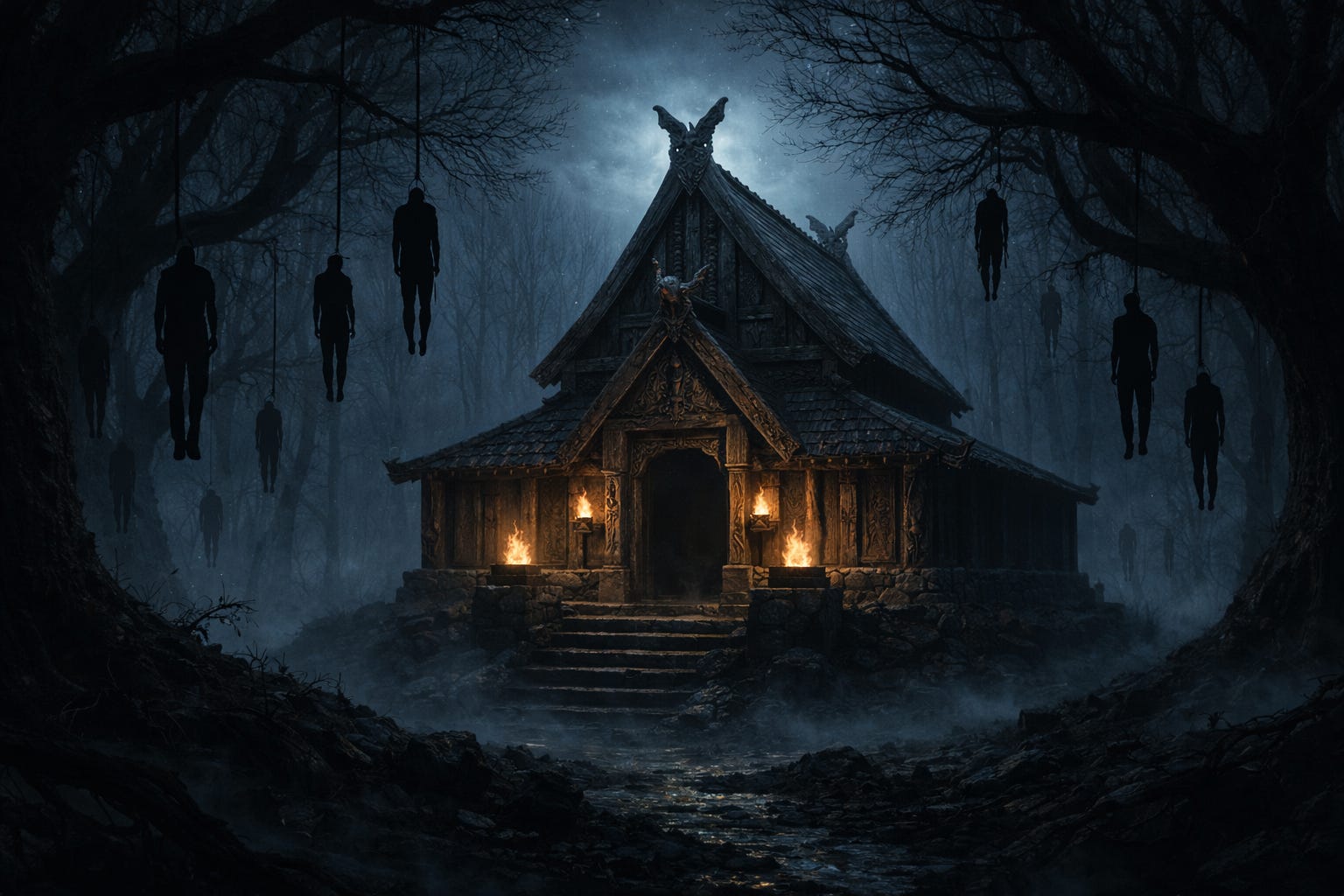
Every Germanic pagan has surely read or at least heard about the sacrifices in Uppsala, Sweden. Some find it unpleasant because it supposedly shows a barbaric side of the old custom that one would prefer to hide. Others simply accept it with a resigned ‘that’s just how it was back then’. And a few flaunt it because it supposedly shows how archaic, brutal and therefore somehow cool their old beliefs are.
The claim that these mass sacrifices ever took place (at least in Uppsala) comes from only one written source, and there are several problems with it.
Let’s delve a little deeper into the subject.
1. Written records on Uppsala
Let us first look at the original quote:
Adam of Bremen, Gesta Hammaburgensis ecclesiae pontificum (Deeds of the Bishops of Hamburg; written 1070-1076), Book IV, Chapters 26-27
Brief information about the author:
Adam of Bremen was born some time before 1050 and died probably in 1081/1085. He was of Saxon-North German origin.
When he wrote his great work, he was a cleric/scholaster (head of a cathedral school) at Bremen Cathedral and worked in the archdiocese of Hamburg-Bremen.
Original Latin text:
“Nobilissimum illa gens templum habet, quod totum ex auro paratum dicunt, in quo statuas trium deorum colit populus, ita dispositas, ut potentissimus eorum Thor in medio solium habeat, hinc Wodan, illinc Fricco locum possideat.
Thor, inquiunt, praesidet in aere, qui tonitrua et fulgura, ventos et imbres, serena et fruges gubernat. Alter, id est Wodan, bellis praesidet et hominibus virtutem contra inimicos ministrat. Tertius est Fricco, pacem voluptatemque mortalibus largiens.
Si pestis et fames imminet, Thor idolo libatur; si bellum, Wodan; si nuptiae celebrandae sunt, Fricco sacrificium offertur.
Sollemnitas autem communis omnibus provinciis est singulis novem annis, ad quam ex omni Sueonia convenire solent. Sacrificium tale est: ex omni animante masculini sexus novem offeruntur, quorum sanguine deos placari mos est.
Corpora autem suspenduntur in lucum, qui proximus est templo. Is lucus adeo sacer est gentilibus, ut singulae arbores in eo morte vel putredine victimarum credantur divinae.
Est etiam ibi fons, ubi sacrificia fieri solent, in quem vivus homo immergitur; si non invenitur, votum populi ratum habetur.“
English translation:
“This people has a very famous temple, which is said to be made entirely of gold. In it, the people worship the images of three gods, arranged so that the most powerful of them, Thor, sits in the middle, with Wodan (Odin) on one side and Fricco (Freyr) on the other.
Thor, they say, rules over the air; he controls thunder and lightning, wind and rain, fair weather and the fruits of the earth. The other, Wodan, wages war and gives people courage against their enemies. The third is Fricco, who gives mortals peace and sensual pleasure.
When epidemics or famine threaten, sacrifices are made to Thor; when war threatens, to Wodan; when weddings are to be celebrated, to Fricco.
Every nine years, a joint festival of all provinces takes place, to which people come together from all over Sweden. The sacrifice is of the following nature: nine male creatures are offered up, and their blood is used to appease the gods.
The bodies, however, are hung up in a grove adjacent to the temple. This grove is considered so sacred by the pagans that every single tree is regarded as divine through the death or decay of the sacrifices.
There is also a well there where sacrifices are made: a living person is immersed in it; if he is not found again, the vow of the people is considered accepted. “
This passage has been quoted, interpreted and discussed thousands of times and used as an argument against paganism.
Adam wrote his work at a time when the Svear tribe was in political turmoil because kings came and went (ca. 1060-1080). Some of the kings were probably already christian, but most of the tribe was still pagan.
Other written sources also mention Uppsala
- Snorri Sturluson reports in his Ynglinga saga (13th century) on Uppsala as the royal residence of the Ynglings, on burials (royal graves) and sacrificial rituals (blót), but without describing a temple building in the sense of Adam.
- Saxo Grammaticus, in his Gesta Danorum (around 1200), knows Uppsala as a religiously significant place, mentions sacrifices and sacred acts, but does not report on a temple.
- Individual verses of skaldic poetry (e.g. Þjóðólfr ór Hvini and Eyvindr skáldaspillir) indirectly refer to Uppsala as a centre of power, a place of royal legitimation and a place of blót in the context of the exercise of power. But here, too, there is no mention of temple architecture or sacrifices in the sense described by Adam of Bremen.
While Adam of Bremen offers an exceptionally detailed description of a pagan place of worship in Uppsala, all other sources differ fundamentally in terms of their nature and content. Adam’s account is thus unique in its specificity. He adds a unique narrative embellishment to the otherwise not explicitly mentioned image of a sacral legitimised centre of power, which is neither repeated nor elaborated upon in the other written traditions.
2. Archaeology in Uppsala
Is there archaeological or other evidence for the sacrifices in Uppsala described by Adam of Bremen?
Whether the sacrifices in Uppsala (now Gamla Uppsala in the province of Uppsala län in Sweden) described by Adam of Bremen actually took place is historically and archaeologically controversial.
Archaeological evidence of ritual use of Uppsala
What seems certain from an archaeological and cultural-historical perspective:
- Gamla Uppsala was an important centre for centuries, both politically and religiously, as well as in terms of burial culture. There are hundreds of burial mounds and tumuli; originally, there are said to have been 2,000-3,000 burial mounds, but today only about 250 remain.
The three large royal burial mounds (known as Kungshögarna) that still stand there today date from the Migration Period or the pre-Viking/early Viking period and show that Gamla Uppsala was a centre of political and cultural power long before christianisation.
Post holes were found under the present-day church in Gamla Uppsala, indicating the presence of large wooden buildings in the past, possibly a hall or cult structure. At least one large wooden structure existed in the centre of Gamla Uppsala, which is estimated to have covered an area of around 200 m² and is thought to have been built around the 6th century. This suggests that the site was used for gatherings or cult purposes for a long period of time.
- In addition to the church, a plateau (the old royal estate plateau) was also identified, on which relics of a large hall or assembly building were found, indicating the site’s functions as a place of power and assembly.
These are possible candidates for a cult or assembly house similar to the temple described by Adam.
- Some archaeological interpretations suggest that the area around Gamla Uppsala was associated with cultic use, sacred rituals and burials, i.e. a kind of cultic centre, as is also recorded in writing.
- Some finds from this region and other parts of Scandinavia indicate animal sacrifices or offerings at burials, which at least partially corresponds to the generally documented sacrificial cult of the heathen religions in the north.
These findings show that Gamla Uppsala was indeed an important centre of pre-christian religion, rule and burial culture, and that the site was of central importance for many generations.
The description of human sacrifices, such as numerous people and animals being hanged or thrown into a sacred well every nine years, as described by Adam, is interpreted by many historians as greatly exaggerated or as christian propaganda.
Adam’s account is not based on his own experience, but on reports from third parties (eyewitnesses or oral tradition), which makes its reliability regarding the details of the sacrifices questionable.
To date, there are no archaeologically proven findings in Gamla Uppsala that clearly indicate large-scale human sacrifices; e.g. no human remains in a sacrificial grove, in a well or similar, as described by Adam. The grave finds mainly concern burials, not sacrifices.
An analysis of the research situation concludes that some elements in Adam’s account could well be based on authentic traditions, such as the existence of an early place of worship with halls and ritual sites.
At the same time, many experts emphasise that the report should be read with caution and that the spectacular details (human sacrifices, hanging of animals and humans, a ‘golden’ temple, sacred spring) are not supported by material evidence.
In general, it seems more plausible that ritual acts took place, especially animal sacrifices and cult celebrations, while large-scale human sacrifices were rare at best and may not have taken place at all.
The reason why many historians and archaeologists are sceptical is that there is no reliable evidence of human sacrifice.
Although there are indications of wooden buildings and meeting places, archaeological investigations provide no clear evidence of a temple building on the scale described by Adam. The interpretation of the post holes as a ‘temple’ has since been strongly questioned.
The wooden structures and geophysical measurements found in recent investigations originate in part from very different construction phases and cannot be reliably dated to Adam’s time period or the supposed great sanctuary.
In particular, there are no confirmed archaeological finds, no skeletons, no hangings, no sacrificial pits, no sources with references to drowned people that would reliably confirm the dramatic descriptions of sacrifices (human and animal sacrifices in large numbers, hangings, live drowning).
Critical recent literature does not regard many elements in Adam as authentic tradition but as a christian-influenced representation of heathen religion with all its clichés, i.e. possible myth, exaggerated perception of foreigners, propaganda.
This means that the spectacular human and animal sacrifices described in the medieval account have not been verified archaeologically.
What do current reports say about the likelihood that human sacrifices actually took place on a large scale in Uppsala?
The Swedish excavation reports (especially Upplandsmuseets rapporter [Reports of the Upplands Museum] from 2013, 2015 and 2024, as well as Arkeologerna [The Archaeologists] from 2015 and 2018) state that not a single finding supports the idea of regular or large-scale human sacrifices as described in the report by Adam of Bremen.
Nor do they say that it is impossible. Essentially, they say that there is no archaeological evidence to support it.
A summary based on the findings
a) No human remains in connection with sacrifices
Excavations in the critical areas (terraces, ‘sacrificial grove’, areas with rows of posts and cult pits) revealed:
- no foreign object deposits,
- no severed body parts,
- no ‘sacrificial shafts’,
- no deposits of dead bodies,
- no pits containing human bones.
If people had been hanged, drowned or buried, the density of finds in the area would statistically suggest some indication of this, but there is a complete lack of evidence.
b) Animal sacrifices: theoretically possible, but archaeologically marginal
- In comparable central sites in Scandinavia, slaughter waste, bone concentrations and burnt sacrifice horizons are occasionally found.
- In Gamla Uppsala, isolated animal bones are found, but no systematic sacrificial sites.
In other words, no ‘mass slaughter sites’ or ‘cult deposits’.
c) Mass visibility
- The excavation areas in the centre (terraces, hall area) are so well documented that one would expect structures or profiles to be visible (deposits) if human sacrifices had taken place there.
- The reports explicitly state that the stratigraphic sequences do not show any unusual deposits that could be interpreted as human sacrifices.
d) Textual criticism within archaeology
- Swedish archaeologists essentially say that Adam’s text may be based on real rituals, but its dramatic elements (mass sacrifices, hangings, drownings) are exaggerated and cannot be verified by findings.
- Methodologically, they assume that there may have been minor human sacrifices, but there is no evidence of systematic or ritualised series.
e) Interpretation of the ‘Offerlund’ (‘sacrificial grove’ or ‘sacrificial forest’) excavations (published in Upplandsmuseet – Rapport [Upplandsmuseum - Report] 2015:30)
The ‘Offerlund’ reports are important because if Adam’s ritual site was anywhere, it would have been here.
Results:
- Cult landscape? Yes.
- Central gathering function? Yes.
- Symbolism? Yes.
- Reality of animal deposits? Low, scattered.
- Human sacrifice: zero evidence.
In summary, archaeologists say that the site was sacred, but not recognisable as an ‘execution site’.
f) What about the well?
Adam’s ‘well’ is topographically conceivable. (Topography describes the surface of the terrain, i.e. the arrangement of mountains, valleys, rivers and other natural or artificial features.)
But there are no finds in water deposits (no bones, no organic deposits in the cultic sense).
The reports conclude that if the source had been an intensive sacrificial site, we would have found something, but there is nothing.
g) Probability assessment from an archaeological perspective
Highly probable:
- Regular cult gatherings.
- Feasts, celebrations, political rituals.
- Perhaps exceptional rituals (animal sacrifices).
Periodic human sacrifices with a high degree of organisation are neither proven nor probable.
The reports see no positive evidence and characterise Adam’s account as literary exaggeration.
If human sacrifices did occur at all (which is not unheard of in North Germanic cultures), then they would have been isolated, not systematic, not periodic, and not archaeologically detectable as a regular ritual.
Anders Hultgård, The Sacrificial Festival at Uppsala: A Comparative Perspective (2022)
In this recent study, Swedish religious scholar and theologian Hultgård critically analyses what could originate from genuine local oral traditions and what are more likely christian codes. He sees traces of a genuine cultic festival in some ritual elements, but emphasises that the ‘nine-yearly human sacrifices’ cannot be reliably verified historically.
Other approaches evaluate the site as a kind of mythological-political-social centre: the combination of burial mounds, cult site, meeting place and centre of power suggests that religion, politics and social order were closely intertwined there. Symbolic sacrifices, perhaps animal sacrifices or libations, as were common in ancient Germanic religions, may have played a role, but not necessarily bloody human sacrifices.
Hultgård shows that elements such as sacrificial cycles (e.g. every nine years) and cult numbers (the “9”) were culturally anchored, but he warns against equating this with the pictorial representation of human sacrifices.
3. Why is the alleged mass sacrifice of humans emphasised so much?
The regular sacrifice of humans has become almost symbolic due to Adam of Bremen’s assertion and its regular repetition in research. One wonders whether he wanted to fulfil a specific purpose beyond mere reporting.
Adam generally expresses negative views about heathens and heathenism
In his work, he repeatedly expresses derogatory and polemical views about heathens, heathenism and heathen religions. This can be seen both in the structure of his text and in his choice of words. Here are some key aspects and examples:
Where the negative attitude is evident:
- For Adam, the ‘pagan other’ serves as a means of constructing the identity and power of christians and the church: In his context, the difference between christians and pagans is often thought of as a contrast between ‘civilisation/true faith’ and ‘savagery/false belief in gods’.
- He uses pagan religion as a resource for argumentation to legitimise the ‘civilised’ christian faith and to underline his missionary and ecclesiastical authority.
In his depiction of cults, e.g. at the sanctuary in the Gamla Uppsala area, he combines descriptions of sacrificial festivals and idolatry with morally judgemental terms (‘pagan’, “barbaric”, ‘superstitious’), which were clearly intended to deter his medieval readers.
Research on Adam’s ‘image of pagans’:
- A modern study by historian Ildar Garipzanov entitled ‘Christianity and Paganism in Adam of Bremen’s Narrative’ (2011) analyses the repeated stereotypical portrayals of pagans (as barbaric, different, heathen) and examines how Adam uses this language to justify the mission to the north, i.e. constructs heathenism as the opposite.
According to contemporary scholarship, Adam’s account served less as a neutral description of Scandinavian religion and more as part of a discourse motivated by missionary and church politics, with a clearly negative slant towards heathen practices.
Examples (in terms of content, not verbatim)
While the original text is in Latin, the following patterns can be identified in modern secondary literature:
- Pagans are portrayed as ‘others’, “strangers”, ‘barbarians’, morally and religiously distant from christians.
- Their religion and rites are characterised as irrational, cruel and superstitious.
- The necessity of christian mission and the church as a civilising and moral duty towards such pagans is emphasised.
It is clear that Adam’s report must be read as a source with strong christian missionary and ideological overtones. His portrayal of heathen religion and places of worship serves less as historical documentation than as legitimisation of christian rule, mission and ecclesiastical influence.
Adam is biased.
He writes on behalf of the Hamburg-Bremen Church and in competition with other ecclesiastical centres. His text serves the mission and self-representation of christianity.
He needs a contrast.
In order for the christian message and mission to appear ‘necessary’ and ‘civilising’, the Scandinavians must be portrayed as religiously deficient, barbaric or dangerous.
Human sacrifice is the strongest rhetorical lever.
If one wants to discredit ‘the other’ morally as much as possible, human sacrifice, animal sacrifice on a large scale, sexual debauchery and demon worship are the classic topoi (literary clichés). These appear throughout Christian polemics against pagans of various cultures.
This is a literary strategy, not genuine ethnography.
Human sacrifice is not primarily ‘information’ in the text, but justification: ‘Their religion is so cruel → therefore mission is necessary.’
Archaeology confirms exactly the opposite.
The archaeological findings from Gamla Uppsala provide no evidence of regular human sacrifice or mass burials.
Examples of Adam’s evaluative and clearly christian/anti-pagan terminology
There are several instances in the Gesta Hammaburgensis ecclesiae pontificum.
a) ‘Seat of idolatry’ + ‘temple for demons’ (Rethra)
(Book II, Chapter 18; about Rethra/Radgosc sanctuary)
- ‘sedes ydolatriae’ (‘seat of idolatry’)
- ‘Templum ibi magnum constructum est demonibus’ (‘There is a large temple built for demons.’)
This is not merely a description; ‘idolatria’/‘demonibus’ is Christian pejorative language.
b) ‘Lost souls of idolaters’ (moral interpretation in the same context)
(Book II, Chapter 18; directly following)
- ‘... perditas animas eorum, qui ydolis serviunt ...’ (‘... the lost souls of those who serve idols ...’)
This is an explicit judgement (pagans = ‘perditae animae’).
c) ‘They still wander around in pagan rites’ (Jumne/Wolin)
(Book II, Chapter 19; about the large trading city)
- ‘Omnes enim adhuc paganicis ritibus oberrant ...’ (‘For all still wander in pagan rites ...’)
The verb oberrare (‘to wander/go astray’) is the evaluative bracket here.
d) Programmatic introduction: ‘On the superstition of the Svear’
(Book IV, Chapter 26; Uppsala passage)
- ‘Nunc de supersticione Sueonum pauca dicemus.’ (‘Now let us say a few words about the superstition of the Swedes.’)
In Latin christian usage, superstitio is regularly the pejorative antonym of religio.
e) Sacrifice as ‘demon sacrifice’ (Scholion on King Anund)
(Book IV, Chapter 27; in the context of the 9-year sacrifice)
- ‘... sacrificium ... nollet demonibus offerre ...’ (‘... ([he] did not want to offer the sacrifice to demons ...’)
Here too: pagan cult = ‘sacrificing to demons’.
f) ‘Thor idol’ (idol terminology instead of ‘gods’)
(Book IV, Chapter 27; functional assignment of cult practice)
- ‘... Thor ydolo ...’ (‘... to the idol Thor ...’)
The term idolum is already pejorative (not neutral deus).
Adams’ depiction of human sacrifice can be classified, based on a critical examination of the sources, as a rhetorical and polemical motif whose function is to enhance the christian self-image and morally disparage the pagans. The archaeological evidence completely contradicts the existence of an actual cycle of human sacrifice.
4. Adam copies important parts of his description of pagan culture from older writings
In Adam’s work, his dependence on older literary patterns is particularly strong when he writes about religion, rituals and the ‘pagan culture’ of the northern peoples.
He works in a compilatory manner, not systematically or ethnographically. His sources can be divided into three groups:
- Contemporary informants such as clergy, merchants, envoys
- Written sources such as ancient authors (especially Tacitus, Solinus, Isidor)
- Theological interpretative frameworks from Christian missionary literature
He does not separate these levels clearly.
Where Adam does not primarily rely on older writings
is in the ecclesiastical and political history of missionary activities, the founding of dioceses, lists of kings, and conflicts between the archdiocese of Hamburg-Bremen and Scandinavia. These descriptions are comparatively independent in Adam’s work.
Here he uses archbishop Adalbert of Bremen (born around 1000; in office 1043-1072), whose pupil and protégé he was, as his main source of information. Adalbert was an influential imperial politician and missionary strategist who attempted to expand the archdiocese of Hamburg-Bremen into a Nordic church centre.
He also drew on documentary evidence and contemporary events.
These passages are historically useful, albeit biased.
Where Adam’s text is strongly influenced by literature
are religion, cult and ‘heathen mentality’.
Here we see classic ethnographic topoi, ancient barbarian stereotypes and christian demonisation.
Particularly affected are:
- Sacrifices (especially human sacrifices)
- Divination & omens
- Temples & groves
- Moral concepts
- Kingship as sacred rule
It is precisely this area that is most strongly influenced by older writings (more on this below).
Why the ‘culture of the northerners’ is so affected:
a) Structural problem
Adam himself never visited Scandinavia, had no direct access to heathen rituals and wrote from a missionary perspective. He therefore resorts to tried and tested explanatory patterns and adapts the unknown to the familiar. Ancient ethnography provides him with the language to describe the unfamiliar.
b) Selective informants
Adam’s informants were christians, often interested in missionary work and in some cases culturally alien, who reported spectacular elements and borderline cases and exceptions as if they were the norm.
Adam generalises these.
For internal comparison:
- Churches and dioceses are explained in a sober, chronological manner
- Kings and politics are presented in a relatively concrete manner
- Paganism is presented in a dramatic, typological manner
- Rituals are explained schematically
- Morality is presented dualistically, with christian morality as ‘good’ and heathen morality as ‘evil’
This shows that the degree of literary construction increases with cultural unfamiliarity.
When Adam writes about the pre-christian religion and culture of the northern peoples, he draws heavily on older ethnographic and theological patterns of interpretation.
The further he moves away from his own sphere of experience and administration, the more literature replaces observation.
While his information on church and political history is based on contemporary information, his descriptions of cults and religion are primarily literary constructions and can only be used as historical evidence to a limited extent.
The further Adam of Bremen moves away from the administratively comprehensible sphere, the more literary his account becomes. His descriptions of northern heathenism are less ethnographic observation than the continuation of ancient barbarian topoi in the service of christian missionary rhetoric.
The source value of his work is therefore low for the reconstruction of real practice, but high for the history of ideas of christian perceptions of paganism.
Now I would like to take a closer look at the sources that Adam either copied directly or which at least influenced him.
Let’s start with the source that is likely to be responsible for the claim of mass sacrifices.
Thietmar of Merseburg, Chronicon (written between approx. 1012 and 1018), Book I, Chapter 17 (according to the usual chapter numbering)
Thietmar of Merseburg (975/976-1018) was a Saxon nobleman, clergyman and chronicler of the early 11th century.
He came from the Saxon high nobility, had close ties to the Ottonian elite and was Bishop of Merseburg from 1009.
Thietmar is not a neutral observer, but it is precisely his partiality, self-criticism and proximity to events that make him one of the most reliable insider accounts of the empire around 1000.
His chronicle is contemporary, autobiographical in places, and was not compiled posthumously, but continuously expanded by Thietmar himself. In it, he reports on events from the late 9th century to his own time.
The aim of the work is to recount the history of the East Frankish-German Empire, focusing on the Ottonian imperial dynasty, the imperial church, the Saxons and the Slavic mission. Information about Scandinavia is not a focus, but rather an external periphery. It does not contain a coherent chapter ‘about Denmark’, but rather statements scattered episodically throughout the work that are strictly functional in terms of imperial politics.
One of these passages reads:
Original Latin text:
‘Est et alius locus in eodem regno (regnum Danorum), nomine Lederun, ubi post mortem regis IX annis completis omnes primores regionis conveniunt et XCIX homines et totidem equos, cum canibus et gallis, immolant.’
English translation:
‘There is also another place in the same kingdom (the kingdom of the Danes), called Lederun (Lejre), where, after the death of the king, when nine years have passed, all the nobles of the land gather and sacrifice ninety-nine men and as many horses, together with dogs and roosters.’
Thietmar describes here a cyclical grand sacrifice in the Danish royal centre of Lejre, which he calls Lederun.
His information about Denmark and Lejre is not based on his own observations, but on oral tradition and reports from third parties. However, it is older than Adam of Bremen and therefore takes precedence in terms of source chronology.
Thietmar of Merseburg mentions the Danes not as an ethnographic object, but as a political actor in the northern border region of the empire. Their religion is only discussed insofar as it explains political unreliability.
He writes not from a cultural-theological perspective, but from an annalistic-political one.
The fact that Thietmar, a contemporary of the christianisation of Denmark, does not provide any spectacular reports of cults or sacrifices strongly suggests that Adam’s drastic descriptions do not reflect contemporary general experience.
Is there archaeological evidence for the sacrifices mentioned by Thietmar?
For Lejre/Lederun, there is currently no archaeological evidence that clearly confirms such a mass killing of 99 people, 99 horses, dogs and roosters in a 9-year cycle, or a predominance of horse/dog remains as sacrificial offerings.
However, there is evidence (which roughly fits with a ‘sacrifice/celebration ritual’):
a) Ritual/deposit contexts have been discussed in the Lejre region, including a large pile of stones/flint (interpreted as a possible hørg [a type of stone altar]) at Mysselhøjgård: Fire-affected stones, many animal bones in pits/layers and ‘special’ finds were interpreted as evidence of sacrificial practices.
b) At the same time, this is precisely the crucial point: human bones are not present in this material, and dog or horse bones are not dominant; instead, common domestic animals predominate, with additional hunting and fish remains.
Classification based on research (source-critical and archaeological findings combined):
Rudolf Simek emphasises (in ‘The Sanctuaries in Uppsala and Lejre and their Literary Contexts’ [2022]) that although Thietmar’s report on Lejre is clearly worded (99 people, etc.), but that the continuation of such a large-scale sacrifice at the time of writing was highly unlikely and that, by the end of the 10th century at the latest, Lejre could hardly be considered a ‘major sacrificial site’ in the sense described.
It is important to note that there is archaeological evidence of human sacrifice in Scandinavia (e.g. the Tollund Man and the Huldremose Woman), but not specifically as a Thietmar-Lejre ritual. The National Museum of Denmark, for example, cites sacrificial deposits in wells/pits (including in the vicinity of Trelleborg [the one on Zealand in Denmark, not the one in Skåne in present-day Sweden]) as archaeologically verifiable examples.
Lejre provides evidence of ritual activities/sacrifices (mainly animal bones, flints/deposits), but no direct archaeological confirmation of the mass killings of humans claimed by Thietmar or the specific 9-year pattern.
Further borrowings by Adam
Of course, Adam does not only borrow from Thietmar. Below, I present a small, incomplete, but source-critical list of clearly identifiable passages in which he recognisably paraphrases or borrows from older ancient or early medieval authors and inadmissibly projects their statements onto the Scandinavians. I will limit myself to cases in which the text structure, choice of motifs and logical argumentation clearly indicate literary dependence.
a) Belief in omens and divination
Source: Tacitus, Germania 10
Adam: Gesta Hammaburgensis IV, 26
Tacitus:
- Oracle of lots with virgulae (wooden sticks)
- Observation of horses
- Birds as omens
- Consensual, collectively confirmed signs
Adam:
- Describes exactly the same practices among the Sueones/Dani
- No differentiation of place or time
- No new observations, no source references
- Structure and sequence correspond almost schematically to Tacitus, and he quotes him almost verbatim
Adam adopts Tacitus’ Roman-Germanic divination scheme and applies it uncritically to Scandinavia, even though horse oracles are only sporadically documented there and bird oracles are hardly traceable archaeologically or literarily.
This is a classic transfer of ancient ethnography.
b) Sacred king & divine legitimacy
Source: Tacitus, Germania 7-8
Adam: Gesta II-IV
Tacitus:
- Kings by descent, not by power
- Sacred function more important than political
Adam:
- Applies this model to Swedish kings
- Kings as religious mediators
- Temple affiliation (especially Uppsala) as centre of power
The problem is that Scandinavian kingdoms of the Viking Age are military-dynastic and not purely sacred.
Adam uses an ancient paradigm of rule to exoticise pagan kings.
This is anachronistic projection.
c) Human sacrifice and cruelty topos
Template: Roman ethnography (Tacitus, Caesar, Pomponius Mela)
Adam: Gesta IV, 26-27 (Uppsala)
Topos structure:
- ‘Barbarians’ sacrifice humans
- Blood rites
- Cyclical large-scale sacrifices
- Symbolism of numbers
Adam:
- Adopts exactly this dramaturgy
- No eyewitnesses
- No independent Nordic parallels
- Symbolism of numbers clearly literary
It cannot be ruled out that sacrifices existed, but the depiction, extent and ritual form follow classical Roman-Christian horror ethnography, not verifiable observation.
d) Nature religion without temples (contradiction within Adam)
Source: Tacitus, Germania 9
Adam: Gesta II, 26 and IV, 26
Tacitus:
nulla simulacra, nullum templum (no images of gods, no temples)
Adam:
- claims on the one hand that gods dwell in forests and groves
- on the other hand, describes a monumental temple in Uppsala
Adam combines incompatible strands of tradition because he adopts older texts without critically integrating them.
He shows compilatory work, not ethnographic work.
e) Description of climate and peripheral world
Source: ancient geography (Pliny the Elder [1st century], Solinus [Gaius Julius Solinus; 3rd century], Isidore of Seville; 6th-7th century)
Adam: Gesta IV
Motifs:
- Extreme cold
- Long nights
- Infertility
- Proximity to the end of the world
Topoi of ancient descriptions of the periphery, not empirical knowledge of Scandinavia.
f) Moral dichotomy: ‘pure pagans’ vs. christians
Source: christian missionary literature
Adam: throughout
Schema:
- Pagans = ritually correct, but demonic
- Christians = morally superior
- Pagans act ‘out of tradition,’ not out of reason
This is not a historical finding, but a theological interpretative framework.
Adam of Bremen is therefore not a primary source for heathen religion, but rather:
- Compiler
- Missionary writer
- Heir to ancient ethnography
His texts are only usable if one systematically distinguishes between observation, tradition and topos.
A fundamental question: What is the Roman ‘topos of cruelty’?
In Roman ethnography, human sacrifice is not a neutral finding, but a marker of cultural inferiority.
It fulfils three functions:
a) moral demarcation (Rome = civilitas [affability, politeness, sociability], others = feritas [ferocity, crudeness])
b) explanation of political violence (legitimises conquest/mission)
c) dramatisation of foreignness (edge of the world = edge of morality)
This topos remained stable for centuries and was seamlessly adopted by christian authors such as Adam and Thietmar.
Example Tacitus: the controlled, ‘dignified’ topos of cruelty
Tacitus, Germania (especially cap. 9, 10, 12, 39, 40)
Tacitus is reserved, but shapes the structure.
a) Human sacrifice as a religious boundary marker
Germania 9 / 40 (on the cult of Nerthus):
- ritual killing (drowning of cult servants)
- no details
- no numbers
- no spectacle
Effect:
‘It happens, and precisely because it is not embellished, it seems archaic and eerie.’
Tacitus establishes:
- sacrifice = sacred
- sacrifice = foreign
- sacrifice = not Roman
b) Sacred punishment (Germania 12)
- Traitors are hanged
- Dishonourable people are sunk in the moor
- Location (grove, swamp) = sacredly coded
The decisive factor here is that punishment and sacrifice become blurred.
Tacitus thus provides the basic model that later authors escalate: ‘Religiously framed violence = sign of barbaric order’
c) What Tacitus does not do
- No cyclical large-scale sacrifices
- No mass killings
- No numerology
- No moral outrage
Tacitus is a model in structure, not in intensity.
Example: Caesar (Gaius Julius Caesar; 1st century BC): the escalation to mass topos
De bello Gallico (On the Gallic War) VI, 16–18
This is where the classic block of cruelty, which Adam reproduces in essence, emerges.
a) Human sacrifice as the rule, not the exception
- Sacrifice = frequent
- Sacrifice = systematic
- Sacrifice = communal
Famous motif (referring to the Celtic Gauls, but here representative of all ‘barbarians’):
- Wickermen filled with living humans
- Collective burning
For the first time:
- Quantity
- Organisation
- Regularity
b) Function in Caesar
Caesar’s goal is political:
- Justification of the Gallic War
- Delegitimisation of the Druids
- Moral superiority of Rome
It is important that Caesar must exaggerate, because his text is propaganda.
c) Relevance for Adam
Adam does not adopt the specific wickerman.
But he does adopt:
- Sacrifice as a mass event
- Sacrifice as a collective duty
- Sacrifice as proof of religious depravity
Adam is thus a christian variant of Caesar’s scheme.
Examples Pomponius Mela (1st century) & Pliny the Elder (1st century): Peripheral world + cruelty
Pomponius Mela, De chorographia (On Chorography)
Pliny the Elder, Naturalis Historia (Natural History)
These authors provide the geographical framework.
a) Basic idea
The further away from the Mediterranean:
- the older the customs
- the more primitive the religion
- the more cruel the rites
Human sacrifice appears here:
- not always in concrete terms
- but as an expected practice of the periphery
Cruelty becomes geographically logical.
b) Effect on Adam
Adam describes Scandinavia as:
- the edge of the world
- climatically extreme
- culturally backward
This paves the way for the mindset: ‘Of course they sacrifice humans, because they are at the end of the world.’
Central topos elements and their Roman roots
a) ‘Barbarians sacrifice humans’
- Caesar: explicit, massive
- Tacitus: implicit, selective
Adam turns this into:
- universal practice
- central cult
b) Blood rites
- Caesar: blood as atonement
- Tacitus: blood hardly described, but assumed
- Pliny/Mela: blood as a sign of archaic religion
Adam escalates this to blood as a visible, dripping cult feature.
c) Cyclical mass sacrifices
- Caesar: regular, collective
- Tacitus: cyclical festivals (without mass killing)
Adam combines:
- Tacitus’ cycles
- Caesar’s masses
d) Symbolism of numbers
Roman authors use numbers:
- not statistically
- but rhetorically
Typical are 3, 7, 9 and 100.
Adam:
- 9 years
- 9 beings
- 99 sacrifices
This is literature, not observation.
Addition to d) Where the Roman influence really lies
The ritual significance of the number nine is Germanic, but its literary exaggeration and combination with numbers representing totality follows ancient and christian rhetoric.
The Roman influence lies not in the number 9 itself, but in its rhetorical bundling.
The number 9 was known to the Romans as a sacred number, especially from foreign cultures, particularly from Greek, Celtic, Germanic and Scythian contexts. It is not a genuinely Roman key number.
Adam combines numbers in a literary rather than a sober manner:
- 9 (cycle/ritual)
- humans + animals + gods ‘all together’
This is classic ancient rhetoric: numbers serve to heighten the impression, not to describe.
The large number of victims, 99, is an exaggerated completeness and almost always symbolic, hardly ever real.
These numbers have no internal Germanic logic, but rather a literary and rhetorical function.
Here it must be clearly stated: topos, not observation.
What Adam really adopts
Adam does not adopt individual facts, but rather the Roman model of interpretation, the moral argumentation and the ethnographic dramaturgy.
He replaces the scheme ‘Roman civilisation ↔ barbarians’ with ‘christian church ↔ heathens’.
Adam’s Uppsala report is therefore not in the tradition of Nordic lore, but in the continuity of Roman cruelty topoi. Tacitus provides the sacred framework for violence, Caesar the idea of cyclical mass murder, and ancient geography locates such practices at the edge of the world. Adam combines these elements into a christian missionary policy escalation.
Having shown which late antique and early medieval authorities Adam of Bremen drew on and how he transferred their topoi to the Scandinavian region, we must now ask what effect Adam’s account itself had and how it became a source for later historical images.
Just a few generations after Adam’s death, the Gesta Hammaburgensis was no longer read as a scholarly compilation, but as a reliable account of pre-christian conditions in the north. Passages with a strong rhetorical or symbolic character in particular had a lasting effect and shaped the image of Scandinavian heathenism until modern times.
5. Literature dependent on Adam
What Adam of Bremen began in the 11th century was essentially, if not literally, reproduced and reformulated again and again in the following centuries and up to the present day.
In some cases, the same themes were transferred to the Slavs.
After Adam, central elements of his Uppsala report, such as the temple grove complex, human sacrifice, sacred nature, sacrifice as execution and ritualised regularity, became topoi in medieval historiography that were transferred to Slavs and other non-Christian groups. These transfers are based less on independent observation than on the reproduction of an established pattern of interpretation.
a) The temple-grove complex (templum + lucus)
According to Adam of Bremen
- permanent temple building
- adjacent sacred grove
- clear sacred zoning
Slavic places of worship are later described as:
- templum in silva (a temple in the forest),
- fanum inter arbores (a sanctuary among the trees),
- or lucus daemonum (grove of demons);
even where there is no archaeological evidence of temple architecture.
This is topos, not a transfer of findings.
b) The place of sacrifice as a place of execution
According to Adam
- Hanging of humans and animals
- Bodies displayed in the grove
- Place of sacrifice = place of death
Slavic places of worship are described as:
- Places of ‘cruelty’
- ‘Slaughterhouses’
- ‘Murder sites of the pagans’,
without ritual differentiation.
The moral equation ‘pagan cult = violence’ is established.
c) Human sacrifice as an identity marker of heathenism
Adam explicitly refers to human sacrifice. Cyclical, collective and central.
In later literature, human sacrifice is generalised, decontextualised and often claimed without mentioning the procedure or occasion.
Human sacrifice becomes a generic characteristic of ‘paganism’ rather than a verifiable practice.
d) Numerology without knowledge of numbers
Adam mentions both a cycle of nine and a sacrificial number of nine.
Later texts adopt a cyclical nature, a grand ritual and regularity, omit the number, but retain the idea of a ‘fixed, demonic system’.
Adam’s structured number symbolism becomes a non-specific ritual routine.
e) The pagan priest as counter-bishop
In Adam’s work, the pagan ‘priest’ is a cult figure with authority and proximity to religious and political power.
Later transfer
Slavic ‘priests’ appear as ‘anti-clergy’, as a conscious counter-order to the church and as manipulators of the people.
This is a functional analogy, not an ethnographic observation.
f) Sacred nature = demonised nature
In Adam’s work, groves, springs and trees are sacred.
Nature is imbued with cultic significance.
Later authors:
- Nature cults = demon cults
- Sacred springs = places of devilish deception
- Trees = ‘false altars’
Nature religion is morally delegitimised.
g) The central sanctuary topos
In Adam, Uppsala appears as caput religionis (religious centre).
In later transmissions, Slavic groups are given ‘main temples’, ‘central gods’ and ‘supreme sacrificial sites’, even where a decentralised cult is more likely.
This is a simplification of complex cult landscapes.
These topoi are not ethnographic observations, but rather:
- literary interpretative tools
- missionary-moral schemata
- transferable narrative building blocks
Authors influenced by Adam
Below, I list examples of medieval authors and works that demonstrably make use of individual topoi that are exemplarily bundled in Adam of Bremen (temple groves, human sacrifice, demonised nature, pagan priesthood, etc.).
None of these texts reproduce Adam’s Uppsala complex in its entirety. They take individual motifs and apply them to other groups.
Helmold of Bosau: Chronica Slavorum (Chronicle of the Slavs; 1160s)
Topoi adopted:
- Temple/grove topos
- Idols
- Sacrifice as a sign of pagan obstinacy
- Nature cults as demonic
Not adopted:
- No numerical order
- No cyclical large sacrifices
- No detailed rituals
Helmold uses Adam’s interpretative pattern, not his ‘facts’.
Saxo Grammaticus: Gesta Danorum (Deeds of the Danes; around 1200)
Adopted topoi:
- Sacrifice as part of pagan kingship
- Moral condemnation of pagan customs
- Occasional human sacrifice (situational)
Not adopted:
- No Uppsala model
- No numerical or cyclical scheme
- No grove hangings
Saxo adapts the sacrifice topos, not Adam’s ritual architecture.
Cosmas of Prague: Chronica Boemorum (Chronicle of the Bohemians; 1120s)
Adopted topoi:
- pagan priests
- sacrificial rituals
- sacred nature as the antagonist of the church
No ethnographic detail, but literary typification.
William of Malmesbury: Gesta regum Anglorum (The Deeds of the Kings of the English; 12th century)
Adopted topoi (projected onto the pre-christian Anglo-Saxons):
- Pre-christian cruelty
- Sacrifice as a sign of spiritual blindness
- Natural sanctuaries as a misguided path
Adam’s topoi are applied retrospectively to earlier pagans.
Ordericus Vitalis: Historia ecclesiastica (History of the Church; 12th century)
Adopted topoi:
- Pagans as sacrificers
- Demonisation of non-christian rituals
- Contrast to christian order
Adam’s interpretative pattern is part of the Latin educational canon.
What is unique about Adam:
- complete combination of topoi
- specific location (Uppsala)
- numerical order (nine)
- ritual topography (temple-grove-spring)
All later authors are selective, none are independently parallel.
The topoi of the pagan sacrificial cult, as prototypically bundled by Adam of Bremen, are selectively adopted in the subsequent Latin historiography by authors such as Helmold of Bosau, Saxo Grammaticus, Cosmas of Prague and others. These are not independent confirmations, but rather the reuse of an established pattern of interpretation, the fully developed form of which is found exclusively in Adam of Bremen.
6. Modern times and the direct adoption of Adam’s claims
The examination of Adam of Bremen as a historical author did not begin in the Middle Ages itself, but in early modern times. In the 16th century, the Gesta Hammaburgensis was systematically studied for the first time and used as a source for the history of the pre-christian and early christian North. This reception forms the basis for later secondary literature.
Here are the relevant later (secondary) texts and authors who transmit the motif of the ‘nine-year-old victim of Uppsala’ or parts of it solely on the basis of Adam’s writings, i.e. explicitly not independent sources, but dependent retellings.
a) Olaus Magnus (1490-1557)
In Historia de gentibus septentrionalibus (History of the Northern Peoples; 1555), this Swedish Catholic clergyman describes the sacrificial customs of the northern peoples.
His account in Book III (especially about sacrifices and temples) is an embellishment of Adam’s.
Olaus Magnus’ ‘cyclical depictions of sacrifice’ do not stem from his own knowledge, but from Adam’s rhetorical core motif.
He confirms Adam’s account in essence and reinforces it narratively. In doing so, he integrates it into a broader picture of pagan cruelty.
Typical of him is his emphasis on blood, sacrificial acts and cultic violence without any source-critical distance or questioning of the magnitude.
Olaus does not relativise Adam’s episode, but popularises and emotionalises it.
He writes not in a historical-analytical manner, but in an ethnographic-moralising manner.
b) Johannes Magnus (1488-1544)
Olaus’ brother was also a Catholic clergyman and humanist.
In his work Historia de omnibus Gothorum Sueonumque regibu (History of All Kings of the Goths and Swedes; 1554, printed after his death), Johannes attempts to ‘embed’ Adam’s Uppsala narrative in a historical context.
He invents additional details, but never independently.
Johannes Magnus knows Adam of Bremen well and takes his authority seriously, but he is not uncritical of him. His main interest is the early national history of Sweden, not an analysis of religious history.
Johannes accepts Adam’s account of the mass sacrifice episode in principle and does not reject it.
However, he implicitly relativises it by shifting the sacrificial practice more strongly into a heroic pagan past, interpreting it as an expression of an archaic cult of kings and the state, and not describing it as a permanent, systematically functioning ritual.
It is important to note that he does not repeat the numbers of victims in detail and does not emphasise the cruelty in the sense of Christian polemics.
The focus is on antiquity and not on moral condemnation.
Johannes Magnus defuses Adam’s account without openly criticising it.
For him, Adam’s account of the sacrifices serves as evidence of great antiquity and not as proof of continuing barbarism.
c) Johannes Messenius (1576-1636)
The Swedish writer and historian Messenius comments on and further develops the ‘Uppsala tradition’.
His descriptions in Scondia illustrata (Explanation of Scandinavia; 1700, printed after his death) are explicitly dependent on Adam.
He is the source of many later misconceptions (especially about the Uppsala temple).
He does not treat Adam’s mass sacrifice episode affirmatively, but in a much more reserved and critical manner than Olaus Magnus. His position is a transitional form within early modern reception.
Messenius regards Adam as an important authority on early Nordic history, but as a foreign, ecclesiastically influenced observer whose statements cannot be accepted uncritically.
Unlike Olaus Magnus, he writes without a missionary-moral tone and seems to have no interest in dramatisation.
Unlike Johannes Magnus, he shows a greater sensitivity to exaggeration and tradition formation.
Messenius does not recapitulate Adam’s account of the sacrifice in detail. The episode does not seem to be a central piece of evidence for Messenius.
He assumes that sacrificial acts existed in the pre-Christian North, but that Adam’s account is generalised, vague in terms of time and place, and coloured by ecclesiastical polemics. He thus treats Adam’s account as a tradition about the pagan past, not as documented cult practice.
Messenius links sacrificial acts to early, mythical-heroic phases of history. He does not put forward a thesis of regular, cyclical, state-organised mass sacrifices as Adam suggests. In doing so, he removes Adam’s account from the contemporary context that still resonates with Adam himself.
Messenius avoids the idea of a central, permanently functioning ‘sacrificial centre’, the equation of sacrifice with execution, and the idea of institutionalised cult violence.
d) Antiquarian literature of the 17th-19th centuries
(Often cited by modern authors without source criticism.)
Works in Latin, Swedish and German that repeat the motif of the ‘Uppsala sacrifice’, ‘reconstruct’ the architecture of the temple and even draw plans based exclusively on Adam’s text.
These texts are all dependent, not independent.
In general, a clear arc of development can be described in antiquarian literature from the 17th to the 19th century in its treatment of Adam’s mass sacrifice episode (Uppsala). The decisive factor is not so much new evidence as a change in methodology.
17th century
Adam remains the authoritative figure in the basic trend. The episode is not rejected, but it is downplayed.
Human sacrifice is accepted in principle, but cyclical mass sacrifices are increasingly questioned. Numbers (9, multitude) are understood as symbolic or rhetorical.
A characteristic feature is a shift to a distant, archaic past.
Comparisons with Nordic tradition (sagas, law) provide no confirmation of institutionalised mass sacrifices.
No detailed retelling; rather a summarising reference.
Examples:
- Olaus Rudbeck (the Elder; 1630-1702) - Atlantica (On the Atlantic; 1679)
Adam is used as an anchor of authority to establish Gamla Uppsala as the central sanctuary/“temple” centre and to incorporate it into a large-scale origin narrative (Gothicism/Hyperborean tradition). The sacrifice report is not primarily discussed as a problem, but as material that can be fitted into an interpretative framework.
- Johannes Scheffer (1621-1679) - Upsalia (Uppsala; 1666)
Adam serves as the ‘oldest description’ of the temple; the focus is less on the number of sacrifices than on the localisation/identification (where was Adam’s ‘Uppsala’?) and how this fits into the Swedish construction of antiquity.
18th century
The general tendency is to contextualise Adam rather than read him in isolation.
The episode becomes a problem case rather than proof.
Typical arguments include the organisational implausibility of regular large-scale sacrifices and the lack of internal evidence in Nordic texts. Numerical language is interpreted as a literary device.
Source comparisons (Adam ↔ Thietmar ↔ Nordic texts) are characteristic. Sacrificial practice and literary representation are separated from each other, and a permanent, state-organised sacrificial centre is rejected.
Adam is more frequently examined against other texts and against plausibility; the sacrificial episode becomes a point of discussion rather than a foundation.
Example:
- Erik Julius Biörner (1696-1750) - Nordiska kämpa dater (Dating of Nordic battles; 1737)
Biörner represents the transition to more philologically critical work (editions, introductions, criticism of ‘naive trust’ in traditional material). This applies not only to sagas, but also to the treatment of ancient authorities in general, including Adam, when it comes to cultic ‘evidence’.
19th century
The general tendency is to interpret Adam in a more fragmented way. The mass sacrifice episode loses its status as a factual account.
With greater access to sources and more historicism, the episode remains present but is more often treated as a piece of news to be framed in a source-critical manner.
The typical attitude changes to one that individual sacrificial acts are possible, but cyclical mass sacrifices cannot be proven. The account is considered to be Christian polemically distorted.
Characteristic is the emphasis on source criticism, topoi, genre.
Even at that time, references to archaeology show no confirmation of Adam’s scenario.
The episode serves primarily to analyse Christian perceptions of paganism, not as a correct representation of pagan practices.
Examples:
- Erik Gustaf Geijer (1783-1847) - Svea rikes häfder (The Historical Tradition of the Svea Empire; 1825)
Geijer refers to Adam’s sacrifice/grove motif as a well-known tradition, but the tone is clearly more historical-critical (Adam as a reporter, not as a direct source of evidence). In Geijer’s texts, the Uppsala sacrifice is presented as traditional news (‘he says he saw...’), i.e. already with markers of distance.
- Editions/source collections as multipliers in general
In the 19th century, the impact of the episode grew significantly through editions and source collections: Adam became more accessible and the Uppsala passage was repeatedly reprinted as a ‘classic passage’, paraphrased and incorporated into national narratives, sometimes critically commented on, sometimes passed on as the ‘core of the narrative’. (The role of publishers/editors in the context of Swedish Scriptores projects is discussed as an example.)
In antiquarian literature from the 17th to 19th centuries, Adam’s account of large-scale sacrifices is increasingly relativised. While human sacrifice in pre-Christian Scandinavia is not fundamentally disputed, the massiveness, regularity and institutionalisation of sacrificial practices described by Adam are largely considered to be literary exaggerations, rhetorically exaggerated in terms of numbers and not supported by Nordic tradition. Adam’s mass sacrifice episode is thus gradually transformed from a supposed factual report into a topos to be treated with source criticism.
There is not a single source that confirms Adam’s statements or that originated independently of him.
There are only
1. adoptions,
2. embellishments,
3. mythologising.
No additional information is created, only echoes.
20th century
Early 20th century (cautiously critical, but still fundamentally trusting)
At the beginning of the century, Adam’s account was still widely regarded as essentially reliable, but exaggerated in terms of numbers.
Human sacrifices had taken place, Adam had described real rituals, but with exaggerations (numbers, cruelty).
The episode continued to be used as the main source for Uppsala and was rarely questioned fundamentally.
Reality + embellishment, not fiction.
Example:
- Ernst Arbman (1891-1959)
Arbman deals with Adam in several places, especially in his Untersuchungen zur nordischen Religionsgeschichte (Research on Nordic religious history; 1935-1937).
He saw Adam’s account as fundamentally based on real sacrificial practices, but rhetorically exaggerated. Human sacrifices were not disputed, but their number and regularity were relativised.
Typical of the time is the attitude that Adam describes reality, but with embellishment. No radical break yet.
Mid-20th century (methodological turning point, systematic source criticism)
From the mid-20th century onwards, a systematic questioning of the victims’ accounts began.
The central points are the separation of Adam’s sources of information (hearsay from Denmark) and his own literary embellishment. Comparisons with Thietmar of Merseburg, with similar cycles (9 years) and similar rhetoric of one-upmanship, raise doubts about the reality of large-scale human sacrifice.
The practice of sacrifice is now considered possible, but its massiveness is seen as problematic.
Adam is no longer read as an ‘almost ethnographic witness,’ but as a christian historiographer with an agenda.
His dependence on older topoi, ecclesiastical polemics against pagans, and literary patterns is clearly elaborated.
Thus, the episode loses its status as a descriptive report.
Examples:
- Walter Baetke (1884-1979)
He became a central figure in the demythologisation process. Particularly in his book Die Götterlehre der Snorra-Edda (The theology of the Snorra Edda; 1950), he interpreted Adam as a Christian historiographer with a theological agenda, not as an ethnographic observer.
- Friedrich Lotter (1924-2014)
In particular, in his essay Die Vorstellungen vom Heidentum bei Adam von Bremen (Adam of Bremen’s ideas about paganism; published in: Frühmittelalterliche Studien [Early Medieval Studies], 1973), he analysed Adam’s dependence on ancient and early medieval pagan topoi; comparisons with Thietmar of Merseburg played a major role here.
Typical of the period is the separation of possible practice from literary exaggeration.
Late 20th century (topos interpretation prevails)
Since the 1970s/80s, a much more critical approach has prevailed.
Adam does not describe a specific ritual, but rather a literary condensation of the image of pagans.
Adam’s depiction of mass sacrifice is read as a literary exaggeration within christian mission and border descriptions.
Parallels to ancient barbarian topoi, early medieval demonisation of paganism and numerical symbolism are explicitly named.
Sacrificial acts are historically possible and partly documented.
Cyclical, institutionalised mass sacrifices according to Adam’s model cannot be proven and must be rejected on methodological grounds.
Adam now describes primarily christian perceptions of paganism and not pagan practices themselves.
Examples:
- Rudolf Simek (1954-)
He repeatedly examines Adam’s account, e.g. in Religion und Mythologie der Germanen (Religion and Mythology of the Germanic Peoples; 2003).
He clearly classifies the Uppsala account as a literary-rhetorical construct and emphasises the Christian perception structure.
- John Lindow (1946-)
He also repeatedly examines Adam’s work, e.g. in Norse Mythology: A Guide to the Gods, Heroes, Rituals, and Beliefs (2001).
He does not treat Adam as a source for concrete ritual practice, but rather for discourses on ‘paganism’ in the Christian North.
He treats Adam not as a source for concrete ritual practice, but for discourses on ‘paganism’ in the Christian North.
- Gro Steinsland (1945-)
She also deals with Adam on several occasions, e.g. in Det hellige bryllup og norrøn kongeideologi (‘The Sacred Wedding and Norse Royal Ideology’; 1991).
She is clearly critical of large-scale, institutionalised human sacrifice and emphasises the ideological narratives.
The typical conclusion is that Adam describes a pagan image and not a ritual protocol.
Archaeology and interdisciplinarity
An additional factor in the 20th century is that archaeological findings provide no confirmation of regular large-scale sacrifices or mass ritual executions in Uppsala or comparable centres.
Individual sacrificial finds are contextualised, not generalised.
This reinforces the source-critical interpretation that Adam remains important, but is not verifiable on this point.
Examples:
- Kristina Jennbert (1950-)
Her most influential work is her monograph Animals and Humans: Recurrent Symbiosis in Archaeology and Old Norse Religion (2002/2011)
She concludes that archaeological contexts contradict Adam’s massiveness. Individual sacrifices ≠ systematic large-scale sacrifices.
- Else Roesdahl (1942-)
Her most important work is her non-fiction book The Vikings (1987).
She emphasises the discrepancy between the text and the findings, especially for Uppsala.
The conclusion is typical: textual criticism + archaeology = invalidation of the mass sacrifice model.
Summary
In the 20th century, the assessment of Adam’s mass sacrifice report changed fundamentally. While early research still considered the report to be essentially accurate, a source-critical interpretation prevailed over the course of the century, classifying Adam’s account as literary exaggeration, influenced by rhetorical figures of speech and christian polemics. Regular, institutionalised mass sacrifices have since been considered unproven; Adam’s report is primarily understood as a testimony to the medieval perception of paganism.
Around 2000
In more recent research, Adam’s sacrifice report is no longer rejected outright, but is strongly contextualised.
The Uppsala report is read as a mixture of real sacrificial traditions, hearsay and christian dramatisation.
21st century to date (strongly contextualised, hardly any controversy)
Today, there is broad agreement that the conclusions of the 20th century are to be regarded as correct.
Examples:
- Neil Price (1965-)
For example, in The Viking Way: Religion and War in Late Iron Age Scandinavia (2002), he states that human sacrifice is possible, but that Adam’s model is methodologically untenable.
He emphasises situational, rather than cyclical-institutional violence.
- Stefan Brink (1952-)
Especially in his essay Religion, Cult, Sacred Sites (published in The Viking World; 2008), he makes use of very sober source criticism. Adam as a testimony to Christian missionary rhetoric.
- Anders Winroth (1965-)
He addresses this issue in The Conversion of Scandinavia: Vikings, Merchants, and Missionaries in the Remaking of Northern Europe (2012).
He explicitly places Adam in the context of ecclesiastical border and deterrent texts.
The consensus at the time does not view Adam’s work as an ethnographic report, but rather as a rhetorical-literary construct.
My closing remarks
Against this background, I find it difficult to understand why Adam’s report on alleged cyclical mass sacrifices continues to be treated as historical fact in parts of the Germanic heathen scene today. This is all the more true given that since the 17th century, and with increasing clarity in the 20th and 21st centuries, research has cast doubt on the scale, regularity and institutionalisation of the sacrificial practices described by Adam, based on a critical examination of the sources. The issue is therefore neither new nor unaddressed.
From a heathen perspective in particular, this uncritical acceptance is irritating. Adam’s account is recognisably christian polemical in nature, employing literary topoi, evaluative language and symbolic numbering, and stands alone without confirmation from Nordic tradition or archaeology. The fact that such a text nevertheless serves as evidence of ‘authentic paganism’ contradicts the otherwise frequently emphasised claim to source awareness and reconstruction.
The enduring belief in Adam’s mass sacrifice episode therefore seems to me to be based less on historical evidence than on mechanisms of reception: the power of impressive narratives, reinforcement by modern popular culture (e.g. an episode of the television series ‘Vikings’ that is clearly influenced by Adam’s account, including the human sacrifices) and the lack of communication of one’s own research history. What is being passed down here is not heathen practice, but a christian-shaped image of heathenism. An image that has been critically questioned for centuries and yet remains surprisingly enduring.
Great info for those new to the path. There has been much slander heaped upon our ancestors and it can most certainly be hard to weed out the true from the false.
I was thinking, what if Adam of Bremen interviewed a Nordic pagan and the pagan embellished what happened at Uppsala. Sort of like a bravado type of thing where a man says, "Oh you want to know what goes on there? Let me tell you it's the craziest thing you'll ever hear." It's all exaggerated but Adam believed it. Also, i came to the thought that human sacrifice amongst our ancestors was really capital punishment.